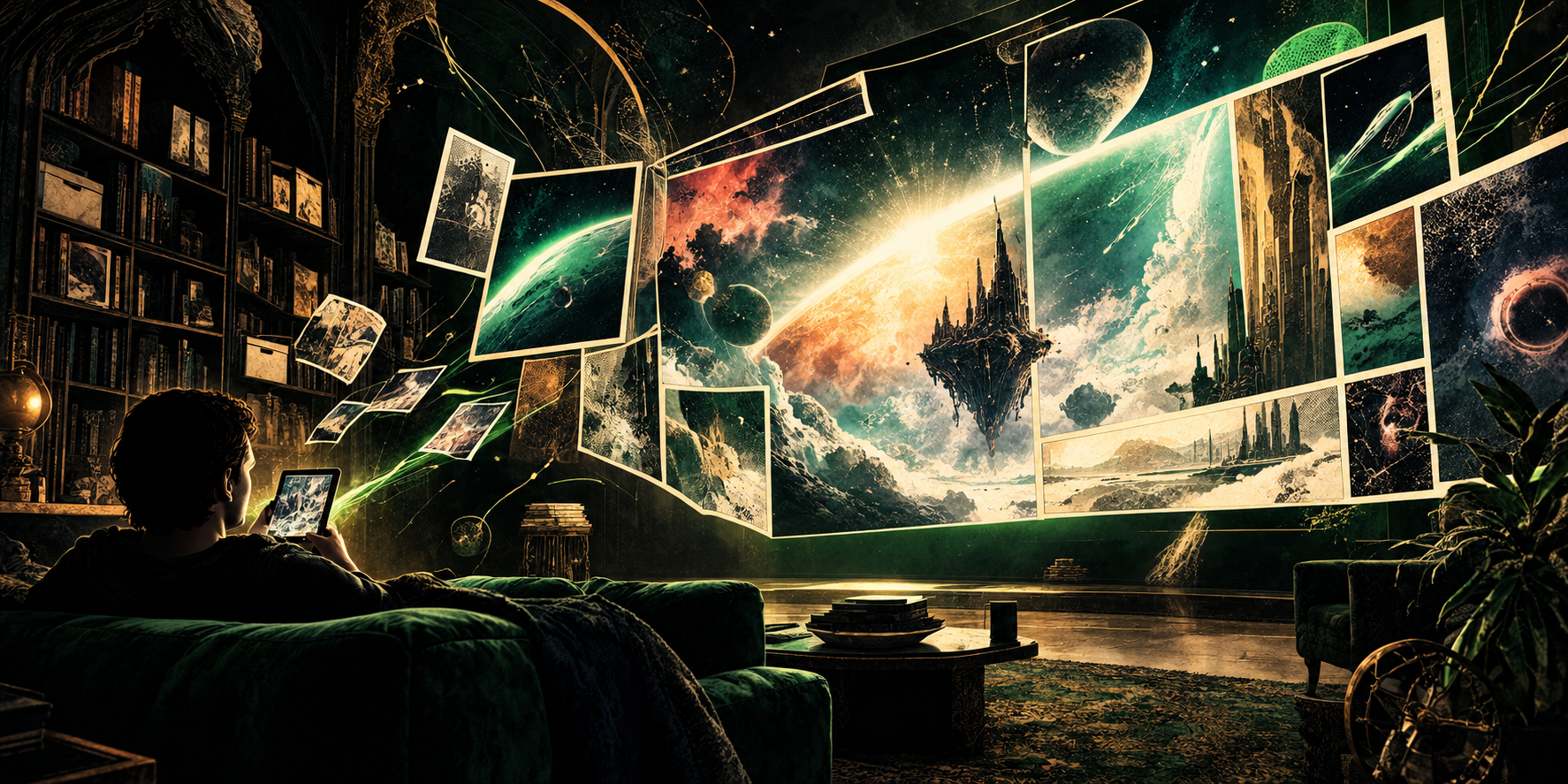
Digital comics have inherited the assumptions of the devices on which they are usually read.
A phone or tablet is held close. The reader touches the page directly. The screen belongs to one person, at one distance, moving through the comic in one familiar way.
Put that comic on a television and nearly every assumption changes.
The screen is larger, but it is also farther away. Touch becomes directional movement. Reading may become shared. A page is no longer something held in the hands; it becomes part of the room.
Longbox began with a question:
What would a comic reader become if the television—not the tablet—were its primary environment?
The room is part of the interface
It would be easy to describe Longbox as a comic reader enlarged for television. But scale is only the most visible difference.
A television has its own physical and social conditions. The reader sits at a distance. Navigation passes through a small remote. The screen may be watched alone, with a partner, or by a roomful of people. Artwork that felt compressed on a tablet can become expansive; a page designed to be held close can become overwhelming when it fills a wall.
The television makes reading spatial
A personal screen encourages private attention. A television makes attention spatial.
That creates possibilities beyond size. A comic can be revisited with another person. Artwork can be studied at a scale closer to a print or projection. A collection that usually disappears into directories and filenames can become visible in the room. Reading can move between concentration and conversation.
None of this replaces the intimacy of a printed book or a tablet held close. Each format creates a different relationship between the reader and the page.
Longbox is built around the idea that the living room deserves a relationship of its own.
The couch is part of the test
Longbox has to be tested from the couch.
A navigation pattern that appears obvious on a development screen may become confusing when operated by remote. Text that looks generous at a desk may be unreadable at viewing distance. A focus state may technically exist and still be too subtle to guide someone through a wall of covers.
These are not finishing details. They reveal whether the product understands its environment.
Another place for comics
Longbox is a specific tool for a specific situation: someone has a personal digital comic collection and wants to experience it on the largest screen in the home.
The television does not merely make the comic bigger. It gives the comic another way to be present.